
Since October 7, I have immersed myself in articles, podcasts, and videos about the conflict in Israel. And I now know how to solve this unending conflict. At some point, someone needs to hit the Palestinians over the head with … Continue reading
Category Archives: Global Issues
Israel Did What?
Reply
Remember Bari Weiss? She left her job as a columnist for the New York Times, started her own Substack, then turned that venture into a new effort called The Free Press. She’s Jewish, somewhat conservative on some issues, so to some of you that will mean that you don’t have to pay attention to anything she says, especially about the Middle East. And it’s true that she is more likely to accept an Israeli version of events than the Hamas version of events.
But then sometimes she reports some verifiable facts, like this story about the damage to a hospital in Gaza that was widely reported yesterday.
Here are the images. Please read the article for the story behind these headlines.
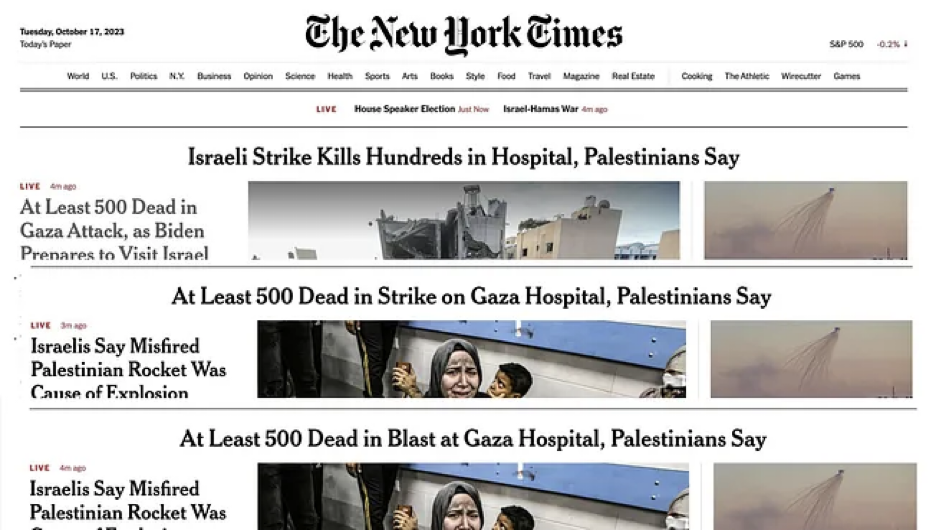
My thoughts: It’s not impossible that Israel could strike a hospital in Gaza. It’s just very unlikely that they would do so deliberately, while it is full of patients, without warning, and without evidence that it was being used as a cover for terrorists. I just trust Israelis more than Hamas and other Palestinians to report the truth.
No, I’m not so naive that I believe everything the Israeli government says. But a vibrant free press exists in Israel, and sooner or later the truth will emerge to clarify any government spin. These headlines all end with “Palestinians Say” which to me suggests that I best remain skeptical until more is known about the event. Why would the NYT be so gullible?
Israel Solves Our Problem With Israel?
Israel. Aargh! My sixth grade social studies teacher (this was 1955) told us that he expected the problems in the Middle East would set off WW III. Basically, for my entire life, it has seemed as though he would be vindicated any day now. You might be thinking that Russia’s invasion of Ukraine would be the most likely location today for the outbreak of a new world war. But I would remind you that Putin and Netanyahu are an interesting pair of leaders; they are frenemies in a way that keeps everyone guessing about where their relationship will go next.
A column by Tom Friedman in the Jan.17 NYT urges Biden to make it clear to Netanyahu that the US will not be Israel’s “useful idiot.” Why is he so vexed right now? He sees a political situation in Israel that could dramatically change the nature of the “only democracy in the Middle East.” He worries that Netanyahu will support ultra-conservative partisans in order to avoid the consequences of his own corrupt behavior. The fallout of adopting policies that further privilege orthodox and ultra-orthodox Jews over conservative, reform, and sectarian Jews, plus non-Jewish citizens of Israel, could precipitate a crisis within Israel that would force the US to seriously re-evaluate its relationship with the Jewish state.
I’m fascinated by Friedman’s confidence that Biden is the one person who could prevent Israel from going over this cliff. Perhaps he could talk some fundamentalist Islamic states into backing off their extremist policies while he’s at it. Meanwhile, we are left to watch from a distance and hope that Israel pulls back from the cliff of extremist policies.
But wait! What if Israel doesn’t pull back? Maybe there are some positive aspects of that scenario. At present, many people throughout the western world are concerned about the fate of the Palestinians in territories controlled by Israel, namely the West Bank and Gaza. A few decades ago, Americans still remembered that at the time Great Britain divided the area into Israel and Palestine, the Arabs in and around the territory refused to accept the division; most continue to reject the division today, yet many Americans continue to hope for a two-state solution to this now hopeless conflict. So: what if Israel doesn’t moderate its internal conflict? Might moderate Israelis leave rather than live within Orthodox constraints? Might the country simply implode with some version of a civil war? (That would be interesting because the Ultra-Orthodox do not serve in the military; they might wish they had taken basic training.) Might Israel’s supporters outside of Russia pull back and say, no, we’re not dragging ourselves into this conflict?
Is it possible that Israel will solve our problem for us? If it ceases to be the only democracy in the middle east, it could also cease to be our concern. Where would moderate Israelis go? I’d welcome them here. Most countries love moderate immigrants. Is another diaspora on the horizon?
While I don’t want Israel to disappear, I also don’t want to see it become an extreme religious state. I want Palestinians and other Arabs to support a two-state solution rather than continue to want Israel wiped off the map. I want the vision of a two-state solution to be viable again. Or maybe let’s just bring back the Ottoman Empire. Jews were accommodated in that era, and maybe that’s the best we can hope for.
If you’re interested in some short histories of the Jewish people and of Islam, here are some links:
History is Messy. Ukrainian History is Very Messy.
Do we have to have wars in order to learn history? The current war in Ukraine has occupied so much of my thinking since it began that I’m exhausted by it – and I’m not there, not fighting, not doing more than donating to some new charities. The only good thing about it is that I’m belatedly learning some important history of eastern Europe and the Caucasus region.
The main thing I’ve learned is that history is messy, very messy. It’s also fascinating. I think I’d study history if I could do college all over again. Unlike North America, Ukraine has been the wild west for millennia (think Sythians (from Iran), Goths, Huns, Mongols, Tatars, Vikings, all players). When pressures or desires elsewhere led people to look for opportunities outside their own back yards, the “emptiness” of Ukraine often captured their imagination. It turns out that the Europeans who settled the east coast of North America were not the only people ever to describe a sparsely populated part of the world that was new to them as empty.
Vikings, yes Vikings, aka “Rus” actually pushed into Ukraine from the Baltic Sea following the Dnieper River, perhaps out of curiosity, but also eager to trade. One of them, named Halvdan, carved his name in Hagia Sophia in Constantinople in the 9th Century. They brought the name Volodymyr, as in Zelensky, Putin, and Volodymyr the Great (who ushered in Christianity in 988) and were part of the creation of the Kievan Rus medieval state.
Over time, the people of Ukraine coalesced and broke apart, were annexed and freed, created alliances and were subdued, yet rose again until they succeeded in creating a viable independent democratic nation when the Soviet Union fall apart. Ukraine has always been multi-ethnic due to the many people who have come to settle or passed through on trading routes. Their language is distinct from Russian, despite what Putin says, but because of the dominance of Russian during Soviet rule and because of the presence of many ethnic Russians even today, Russian is still spoken as a first language by many.
In the 1930s, Stalin starved millions in Ukraine and other parts of Russia in his efforts to collectivize agriculture, an event referred to as the Holodomor. Following the famine, he purged a large number of professionals and intellectuals in Ukraine. (Please do not take my word for any of this. Ukrainian history is far too complex for me to summarize.) World War II brought immense damage and death to Ukraine, and I imagine there are Ukrainians today who remember that carnage while they survey the damage from today’s war. I read recently that there is an effort today to remove any living Holocaust survivors from Ukraine to protect them. If there is any good news from today’s war, perhaps it is that these people are in danger today for being Ukrainian, not for being Jews, and yes, that is good news.
After WW II, Ukraine amended its constitution such that it could participate as a founding member of the United Nations while still being part of the USSR. Thus a national identity was forming while it was developing institutions that it would need as a truly independent nation after 1991. Nothing about the creation of the USSR or its dissolution was easy. Ukraine’s status in both eras was contested from within and without. It’s recent history as a democracy is amazing in many ways. I want it to succeed as a modern, western-facing, secular, multiiethnic state. Perhaps it will serve as a model for the US.
Ukraine Disrupts My Brain
Gallery
Can you read books when war is breaking out? I’ve tried this week, but I just can’t. It was even hard to read lengthy articles about Ukraine that I want to read. I watched Biden’s Thursday press conference, and felt … Continue reading
 Sauk City Blog