NYT: Screams Without Words: Sexual Violence on October 7

There are times when I need to write about something that concerns me, but my fingers won’t move. This has been one of those moments. Can I do this? To put yourself into my shoes for moment, read the article linked to above. Can you even finish it? Can you then compose a blog post about it? Or are you frozen as I am.

It’s not just the horrific descriptions of the violence of October 7. It’s the fact that the violence is being denied, that the NYT felt the need to send reporters to fact check the events. It’s the fact that even now there are people who will deny or excuse the actions of Hamas. So it’s not just the horror of that day, it’s the horror of reactions to it that I cannot comprehend.

The Hamas terrorists who invaded Israel and carried out these unthinkable acts are not martyrs or heroes. They are not even animals. Are they even human in any way? Animals kill for food or to protect their young. They do not commit sexual atrocities. In fact the word atrocities can only be applied to humans behaving outside the bounds of any actions necessary for survival. Perhaps it’s the ability to commit atrocities that sets humans apart from the rest of the animal kingdom. 

People wonder how we’re special. Is it art? Is it language? Is it our problem solving abilities? Yet there are many animals that encroach on our sense of uniqueness in remarkable ways. So perhaps it’s our ability to horrify each other with hideous acts of violence, often, but not only, against women, and then brag about it that really sets us apart. Or our ability to subject people to the sight of family members being raped and tortured and dismembered. Or our ability to deny that these events took place. Or our ability to celebrate the men who commit these hideous acts. 

I should be excited about a new year, but I am in a state of despair. I don’t know how we fix this. 

Peace is Possible?

“The Economist” magazine thinks peace is possible. Their theory is that October 7 shook things up enough that both Israel and the Palestinians want things to change. October 7 and events since then have shaken me up, but I’ve come down on the opposite end of the teeter-totter. I see the end of Israel, and the increasing likelihood of another Holocaust. Perhaps the writers at the Economist don’t think pessimism sells as well as optimism? 

Here’s my reasoning: 1) Peace is unknown in the Middle East since the demise of the Ottoman Empire; 2) The two-state solution was conjured by the British in the 1920s and 30s, but it was never the preferred solution of either the Zionists or the Arabs/Palestinians. (In early iterations, Britain assumed it would be staying in the Middle East and could referee the unfriendly neighbors on occasion.) 3) Like it or not, Gaza voted for Hamas in 2005 just as Israel, through it multi-party system, voted for Netanyahu (many times over). Both want a single state solution (their own state). Israel has citizens who would opt for a two-state solution if it would bring peace, but they are currently not the majority. 

After WW II, when Britain could not get agreement on a solution, and everyone just wanted the Brits to go home, it placed the problem on the doorstep of the United Nations and left. The UN offered a two-state solution, which the Israelis reluctantly accepted. The Arabs and Palestinians rejected it, declared war when Israel declared independence, but lost the war. Jordan annexed the West Bank, Egypt took over Gaza, and Israel began governing the rest of Palestine. Many Arabs lost their homes during that war and continue to demand the “right to return.” Jordan accepted some of these as temporary refugees, but later sent them packing when they tried to take over Jordan. Meanwhile, Jews were purged by every Muslim country in the Middle East, but were accepted in Israel. 

The US tried carrots and sticks to push through a two-state solution in the ‘90s (Oslo Accords), but no deal was acceptable to all. And today, we have a horrendous situation. Currently, it seems the Palestinians are winning the PR war, at least with the “elite” members of European society and the Anglo-sphere. We are, it seems, unable to favor a winner and must always side with the underdog. For sure, the situation in Israel/Palestine is a long-standing, murky feud in which sad stories abound, and there is plenty of blame for all parties. 

But seriously, Israel has done some things right that seem to be ignored by those determined to commit both-sides-ism. Primary example: Arabs living within Israel, i.e. not in the West Bank or Gaza, are citizens, can vote, have representatives in the Knesset and on the Supreme Court. If Muslim or Christian, they can practice their religion unimpeded. Bedouins fare better within Israel than within the territories. 

Israeli citizens can and do protest, argue (eternally), speak and write of their concerns about every issue under the sun. No Arab country boasts such freedom. Who knows what the people of Gaza actually think of Hamas which has not held elections since it was voted into power in 2006. Do you ever wonder what improvements people might have enjoyed if all the money that has been poured into Gaza had gone for improved schools, hospitals, and other infrastructure rather than the immense network of fortified tunnels that shield their fighters? What if Hamas stopped firing rockets into Israel and focused on building an economy and Palestinian culture? 

The militant Islamists who run Gaza teach children every horrid prejudice of history about the Jews next door. They do not hate Zionists. They hate Jews. Honest. It’s that simple. There used to be Arabs who differentiated Zionists, who wanted a Jewish State, from Jews who simply wanted to live in their historic homeland. There were and still are Jews who are anti-Zionists, including a few in Israel. And I believe there are some Arabs who could still accept Jews as a minority population in a country run according to Sharia law. But I fear that most protesters who prance about shouting “From the River to the Sea, Palestine will be Free!” haven’t bothered to even wonder what plans Hamas has for their Jewish neighbors living in Israel. Protesters may envisage a happy place where Jews, Muslims, Christians, atheists and others will live peacefully side by side. I don’t for a single minute believe that that is what Hamas envisions. 

If you read some history of the pre-WW II era and then the role of the Grand Mufti of Jerusalem during the War, this scenario is not what was envisioned. And no one really presses Hamas to describe what would happen to the Jews of Israel if Hamas succeeded in extinguishing the State of Israel. Given recent events, what’s your guess? 

You might share my concern about Jewish settlements in the West Bank. Many people do. But there’s actually a case to be made in support of the settlements (excluding those on land clearly owned by individual Palestinians). Yes, the settlements seem to be a thorn in the side of anyone who supports a two-state solution. But who is that today? Too few Israelis and certainly no Palestinians. In any event, I refer you to an intriguing explanation of why the settlements are legal.*

I have long been a fan of the two-state solution, but I now realize that no Palestinians support such a scheme. The optimists at the Economists think things are so bad right now that both Israel and Hamas need a way out, and a two-state solution might enable both to save face. I know they are way more informed than I am, and smarter too, but I think current circumstances only incentivize Israel to take over all of Palestine giving up all pretense of two states. Could some parts develop the level of autonomy of US states? Of Scotland? Of Cantons in Switzerland? I don’t know, but that’s the best outcome I can see. 

The other option I see is a second Holocaust, this one conducted by the Palestinians with the backing of Iran. Israel may use its nuclear weapons to try to forestall such an outcome, in which case, all hell breaks loose. Truly, that’s how worried I am. May I please be wrong.

Suggestions for further learning:
*Jesusalem and the Israeli settlements according to international law,
lecture by Natasha Hausdorff

Palestine 1936: The Great Revolt and the Roots of the Middle East Conflict, (readable book) by Oren Kessler, 2023

Israel Did What?

Remember Bari Weiss? She left her job as a columnist for the New York Times, started her own Substack, then turned that venture into a new effort called The Free Press. She’s Jewish, somewhat conservative on some issues, so to some of you that will mean that you don’t have to pay attention to anything she says, especially about the Middle East. And it’s true that she is more likely to accept an Israeli version of events than the Hamas version of events. 

But then sometimes she reports some verifiable facts, like this story about the damage to a hospital in Gaza that was widely reported yesterday. 

Here are the images. Please read the article for the story behind these headlines. 
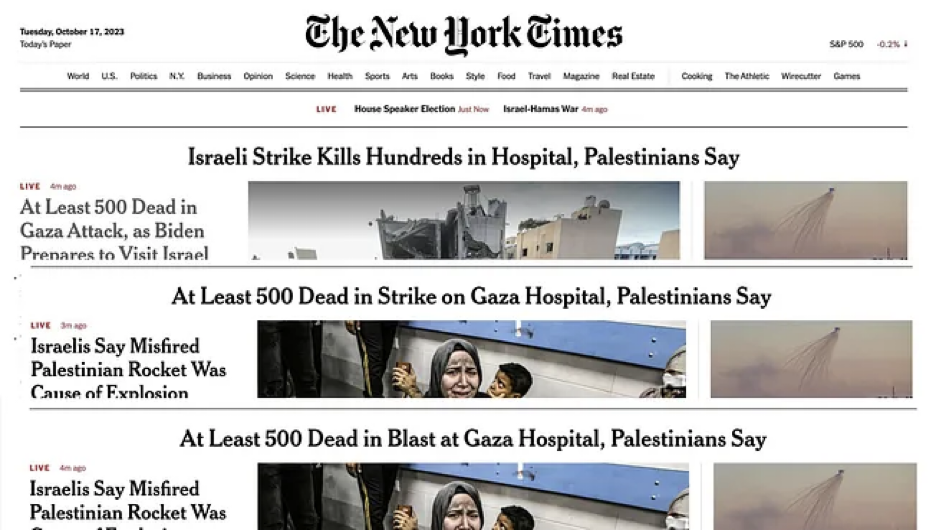
My thoughts: It’s not impossible that Israel could strike a hospital in Gaza. It’s just very unlikely that they would do so deliberately, while it is full of patients, without warning, and without evidence that it was being used as a cover for terrorists. I just trust Israelis more than Hamas and other Palestinians to report the truth.

No, I’m not so naive that I believe everything the Israeli government says. But a vibrant free press exists in Israel, and sooner or later the truth will emerge to clarify any government spin. These headlines all end with “Palestinians Say” which to me suggests that I best remain skeptical until more is known about the event. Why would the NYT be so gullible?

BDS vs Israel: Peace, Anyone?

As I write this, the US news is silent regarding antisemitic crimes. No recent shootings of Jews in synagogues, no take-downs of Jews eating at outdoor cafes in LA. I assume that Hasidim still get harassed on the streets of Brooklyn, and that swastikas still get sprayed onto any structure that might be Jewish, but that hardly qualifies as news nowadays.

The actually urgent news is coming from the streets of Israel where thousands of people are protesting Netanyahu’s plans to remake Israel’s supreme court such that he will have control of it. Until Netanyahu’s return to office last fall, it was fairly easy to be pro-Israel while wishing someone would put an end to the settlements in the West Bank. The rationale went something like, “all countries do deplorable things, but Israel is still the only democratic state in the Middle East.” If the current government succeeds in their judicial overhaul, will we lose that talking point?

Meanwhile, the people behind the BDS movement (Boycott, Divest, Sanction) aim at putting economic pressure on Israel to be nicer to the Palestinians. They have succeeded in gaining support across college campuses and beyond. Perhaps BDS is so successful because it seems to be the primary voice of Palestinians. Regrettably, IMO, it doesn’t support a two-state solution. This comes a shock to many because they are so successful in focusing on Israel’s bad acts that supporters often don’t dig deeper into their information. Essentially, they want Israel to cease to exist, to replace it with a single state with “equal rights for all.” In other words, no Jewish state in a country with an Arab birth rate much higher than the Jewish birth rate. 

If there are any Palestinians and Israelis who still support a two-state solution (I suspect there are and that they are keeping a low profile), they are not organized in the way that BDS is organized. 

Meanwhile, Jews within Israel and abroad have many opinions about the Jewish state, they have many different organizations to promote various opinions, and they have countless journals and websites to promote their views and elicit support.  (I’ll confess that I’m envious of a community in which disagreement is expected; I’m frustrated with people who are so settled on an answer that they don’t look for, and cannot reflect on, new information.)

When I write an article like this one, I generally spend days searching for information about different perspectives. I watch YouTube videos, scour websites, read articles and occasionally an actual book. I’ll share links to some of my sources at the end. One thing that has impressed me this time, is the rhetoric that now defines the BDS campaign and is used by some Jewish organizations as well. 

About the rhetoric: let’s start with settler-colonialism. I tend to think of settlers as people who willingly left one home in search of a better life in some new place many years ago. Nowadays, people migrate, but we don’t tend to think of today’s migrants as settlers. Unless you’re Woke and talking about Israel or white people anywhere at all.

I think of colonialism as the adventures of powerful countries searching for resources or trading opportunities in lands far afield from their point of origin. Colonial powers generally had advantages that enabled them to impose their will on residents of territories they exploited. These are not scholarly definitions, just my personal takes. Do Israelis count as settler-colonialist interlopers? 

Huh? Well, they are certainly not a colonial power; settlers, perhaps, at least back in the late 1800s when many Jews began immigrating in noticeable numbers to areas they associated with their biblical history. This migration enabled them to leave behind frequent, devastating pogroms in Eastern Europe that had prompted them to seek opportunities elsewhere. Some Jews have always lived in the Middle East, and the Arabs were not necessarily enemies. Jews lived successfully within the rules of the Ottoman Empire, though not as equals. Thus their biblical homeland seemed like a logical place to go.

What about charges of apartheid? I would suggest you read this article by the Council of Foreign Relations about Arab Citizens of Israel. Apartheid hardly seems like the right word to me. Does it to you? If so, please take time to comment. Israeli Arabs are not second class citizens under the law in the way of the Jim Crow era in the US. On average, they have larger families, less education, and less income that Jewish Israelis, but in much the same way that black people in the US have not yet caught up with white people on a variety of metrics. I suspect the BDS movement uses the term apartheid because they want people to conjure images of the brutality of the Apartheid regime in South Africa and they want BDS to be blessed with an assumption of the righteousness of its cause.

Then there’s the term occupation. Israel has occupied the West Bank and Gaza since 1967. Rules are never the same in occupied territories as they are in unoccupied areas (ask a Ukrainian if you doubt me). It’s likely that an occupying army will be visible in occupied territories. People might have some amount of autonomy, but that is always subject to the whim of the occupier. Israel’s occupation has been contentious. They have allowed many Israelis to create settlements within the West Bank, a policy that is certainly cringe-worthy to most of us who consider the settlements illegal and want peace. 

Palestinians have a very long list of injustices done to them by Israelis, and the fact is that many Jews in America as well as Jewish Israelis criticize state actions. The Israeli state generally responds that its actions are in response to terrorist actions of Palestinians; often they are correct. But are state actions disproportionate? 

What does BDS say about occupation. BDS demands three things from Israel. #1: Ending its occupation and colonization of all Arab lands and dismantling the Wall. As I’ve said, “colonization” doesn’t make sense to me. So, on to occupation. “all Arab land” deserves some scrutiny. Perhaps they’re just referring to lands occupied after the 1967 war, but actually, BDS supporters say that all of Israel is on Arab land, and they want it all “from the river to the sea.” 

Demand #2 is for equal rights for all citizens of Israel. Funny, that. Some Israelis want equal rights for all citizens, meaning that Orthodox and Ultra-Orthodox Jewish citizens would have to serve in the armed forces and give up other special considerations. In any event, I refer you back to the Council on Foreign Relations article.

Demand #3 is for the rights of Palestinian refugees to return to their homes and properties in accordance with UN Resolution 194:

“refugees wishing to return to their homes and live at peace with their neighbours should be permitted to do so at the earliest practicable date, and that compensation should be paid for the property of those choosing not to return and for loss of or damage to property which, under principles of international law or equity, should be made good by the Governments or authorities responsible.

So, here’s some math: Current population of Israel: 9,000,000; 20% of current population are Israeli Arabs: 1,800,000; BDS claims there are 7,250,000 people with the right of return. Population if all return: 9 million Jews, 9 million Arabs. Hmm. That could work, though, half them, half us? Peace on Earth? If the Jews didn’t want a Jewish State, that could work, but they do want a Jewish State. And why not. Iran? Saudi Arabia? Qatar? 

Here’s another perspective, “What Do Palestinians Want,” from the Washington Institute for Near East Policy. How many words have been spent on Israel and Palestine since 1948? More words than bullets, I’m sure, and many bullets have been fired over that time. I find it exhausting. My sentiments have shifted more than once over the years. For now, I still support the idea of Israel, situated where it is, with some sort of peace between Israelis and Palestinians. I’m absolutely angry that the citizens of Israel have elected Netanyahu again, and that he wants to take over the courts. I hope the protesters are able to prevent this. 

That said, I don’t support BDS. I’m OK with one Jewish state in the world. I don’t see anything constructive in the BDS program, and I see Jewish students on campuses across the country now fearful of “outing” themselves as Jews, Meanwhile, the de-platforming battles are ongoing with both sides scoring wins here and there.

The BDS movement has begun linking to the Black Lives Matter movement in the US claiming that Palestinians are in the same marginalized status as black people in the US. I don’t buy it. For one, I don’t buy the BLM narrative. The status of BIPOC people in the US has improved since the passage of civil rights legislation in the 60s and the end of red-lining in the 70s. 

Without getting hung up on that issue, the situation of the Palestinians in occupied areas is simply not comparable to the status of minorities in the US. Within Israel, Arab Israelis have full citizenship. Within the West Bank they live in an occupied territory and have limited rights. Gaza is its own mess and would do well to stop firing rockets into Israel. Israel, meanwhile, is surrounded by many millions of people who do not acknowledge its right to exist. 

Palestine could have become an independent state in 1948 but chose not to because they wanted Israel gone. Perhaps with the strength of the BDS movement, they will get their wish. But honestly, I think making peace with Israel would be the better path forward. 

Is the BDS movement antisemitic? Short answer: yes. My reasoning is this: I get how Jews came to want, and need, a Jewish state. The Holocaust was a plan to exterminate Jews. When I think about that, and about the antisemitism that exists even here, in a country that has been relatively accepting of Jews, I get why Jews want a Jewish state. They don’t trust us, and they shouldn’t. Sentiments can change, rapidly, in fact. 

Having a “safe place” is something that today’s college students should relate to. Just last week, Stanford Law School students shouted down a judge, Stuart Kyle Duncan, who’s a member of the 5th Circuit. He’d been invited to speak to students, but the heckler’s veto won out because some students claimed to feel unsafe. Prior to that a Hamline University professor, Erika Lopez Prater, was fired for showing, complete with trigger warnings, a classic painting of Muhammed that led a student to feel unsafe. Surely these students can understand how Jews, both in Israel as well as in the Diaspora might feel unsafe given the ancient rhetoric that lies just below the surface today, bubbling up at the first opportunity. 

Palestinians are not without agency in fashioning their own future. Jews are certainly expressing their opinion in the streets of Israel. If they don’t win this week, they won’t be giving up. No one is optimistic regarding Israel and Palestine, but surely people are getting tired of the ongoing conflict. Do conflicts only end when people are exhausted? Or can they end when new leaders appear who are willing to chart a new path forward?

Further reading:

Anticipating Israel’s Counter-Attack: Make the “One Democratic State” Mainstream Again

Critical Race Theory and the Hyper-White Jew

There’s Hope for Israeli-Palestinian Peace

Palestine lost: It’s up to the Palestinian people to share their future now

And a book:

Woke Antisemitism: How Progressive Ideology Harms Jews, by David L Bernstein, 2022

Israel Solves Our Problem With Israel?

Israel. Aargh! My sixth grade social studies teacher (this was 1955) told us that he expected the problems in the Middle East would set off WW III. Basically, for my entire life, it has seemed as though he would be vindicated any day now. You might be thinking that Russia’s invasion of Ukraine would be the most likely location today for the outbreak of a new world war. But I would remind you that Putin and Netanyahu are an interesting pair of leaders; they are frenemies in a way that keeps everyone guessing about where their relationship will go next.

A column by Tom Friedman in the Jan.17 NYT urges Biden to make it clear to Netanyahu that the US will not be Israel’s “useful idiot.” Why is he so vexed right now? He sees a political situation in Israel that could dramatically change the nature of the “only democracy in the Middle East.” He worries that Netanyahu will support ultra-conservative partisans in order to avoid the consequences of his own corrupt behavior. The fallout of adopting policies that further privilege orthodox and ultra-orthodox Jews over conservative, reform, and sectarian Jews, plus non-Jewish citizens of Israel, could precipitate a crisis within Israel that would force the US to seriously re-evaluate its relationship with the Jewish state. 

I’m fascinated by Friedman’s confidence that Biden is the one person who could prevent Israel from going over this cliff. Perhaps he could talk some fundamentalist Islamic states into backing off their extremist policies while he’s at it. Meanwhile, we are left to watch from a distance and hope that Israel pulls back from the cliff of extremist policies. 

But wait! What if Israel doesn’t pull back? Maybe there are some positive aspects of that scenario. At present, many people throughout the western world are concerned about the fate of the Palestinians in territories controlled by Israel, namely the West Bank and Gaza. A few decades ago, Americans still remembered that at the time Great Britain divided the area into Israel and Palestine, the Arabs in and around the territory refused to accept the division; most continue to reject the division today, yet many Americans continue to hope for a two-state solution to this now hopeless conflict. So: what if Israel doesn’t moderate its internal conflict? Might moderate Israelis leave rather than live within Orthodox constraints? Might the country simply implode with some version of a civil war? (That would be interesting because the Ultra-Orthodox do not serve in the military; they might wish they had taken basic training.) Might Israel’s supporters outside of Russia pull back and say, no, we’re not dragging ourselves into this conflict?

Is it possible that Israel will solve our problem for us? If it ceases to be the only democracy in the middle east, it could also cease to be our concern. Where would moderate Israelis go? I’d welcome them here. Most countries love moderate immigrants. Is another diaspora on the horizon?

While I don’t want Israel to disappear, I also don’t want to see it become an extreme religious state. I want Palestinians and other Arabs to support a two-state solution rather than continue to want Israel wiped off the map. I want the vision of a two-state solution to be viable again. Or maybe let’s just bring back the Ottoman Empire. Jews were accommodated in that era, and maybe that’s the best we can hope for. 

If you’re interested in some short histories of the Jewish people and of Islam, here are some links:

History of Islam in 10 Minutes

All Jewish History in Under 18 Minutes